Published by:
CGP EDU Academic Team
Published on: September 13, 2026
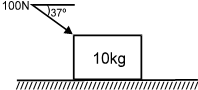
In the figure shown calculate the angle of friction. The block is just about to slide. Take g = 10 m/s 2 .
Text Solution
Verified by ExpertsThe correct answer is:
A
Step 1: Identify the forces acting on the block.
The weight of the block (W) is given by:
$$ W = m imes g = 10 ext{kg} imes 10 ext{m/s}^2 = 100 ext{N} $$
There is also an external force (F) of 100N applied at an angle of 37° to the horizontal.
Step 2: Resolve the applied force (F) into its horizontal (Fx) and vertical (Fy) components:
$$ F_x = F imes ext{cos}( heta) = 100 ext{N} imes ext{cos}(37^ ext{o}) $$
$$ F_y = F imes ext{sin}( heta) = 100 ext{N} imes ext{sin}(37^ ext{o}) $$
Using the known values of sin(37°) and cos(37°) (approximately 0.6 and 0.8, respectively), we calculate:
$$ F_x = 100 imes 0.8 = 80 ext{N} $$
$$ F_y = 100 imes 0.6 = 60 ext{N} $$
Step 3: Calculate the normal force (N):
The normal force is the weight of the block plus the vertical component of the applied force:
$$ N = W - F_y = 100 ext{N} - 60 ext{N} = 40 ext{N} $$
Step 4: Frictional force (Ffriction) is given by:
$$ F_{friction} = ext{Coefficient of Friction} imes N $$
Step 5: Apply the condition of impending motion:
At the point of sliding, the frictional force equals the horizontal component of the applied force:
$$ F_{friction} = F_x $$
Hence, $$ ext{Coefficient of Friction} imes 40 = 80 $$
Therefore, the coefficient of friction is:
$$ ext{Coefficient of Friction} = rac{80}{40} = 2 $$
Step 6: Find the angle of friction (φ):
The angle of friction is related to the coefficient of friction by:
$$ an( ext{φ}) = ext{Coefficient of Friction} $$
Therefore:
$$ ext{φ} = an^{-1}(2) $$
This value can be approximated to find the angle of friction. Using a calculator, we find:
$$ ext{φ} ext{ is approximately } 63.4^ ext{o} $$
Therefore, the angle of friction is approximately 63.4°.
Hence, the final answer is: A.
The weight of the block (W) is given by:
$$ W = m imes g = 10 ext{kg} imes 10 ext{m/s}^2 = 100 ext{N} $$
There is also an external force (F) of 100N applied at an angle of 37° to the horizontal.
Step 2: Resolve the applied force (F) into its horizontal (Fx) and vertical (Fy) components:
$$ F_x = F imes ext{cos}( heta) = 100 ext{N} imes ext{cos}(37^ ext{o}) $$
$$ F_y = F imes ext{sin}( heta) = 100 ext{N} imes ext{sin}(37^ ext{o}) $$
Using the known values of sin(37°) and cos(37°) (approximately 0.6 and 0.8, respectively), we calculate:
$$ F_x = 100 imes 0.8 = 80 ext{N} $$
$$ F_y = 100 imes 0.6 = 60 ext{N} $$
Step 3: Calculate the normal force (N):
The normal force is the weight of the block plus the vertical component of the applied force:
$$ N = W - F_y = 100 ext{N} - 60 ext{N} = 40 ext{N} $$
Step 4: Frictional force (Ffriction) is given by:
$$ F_{friction} = ext{Coefficient of Friction} imes N $$
Step 5: Apply the condition of impending motion:
At the point of sliding, the frictional force equals the horizontal component of the applied force:
$$ F_{friction} = F_x $$
Hence, $$ ext{Coefficient of Friction} imes 40 = 80 $$
Therefore, the coefficient of friction is:
$$ ext{Coefficient of Friction} = rac{80}{40} = 2 $$
Step 6: Find the angle of friction (φ):
The angle of friction is related to the coefficient of friction by:
$$ an( ext{φ}) = ext{Coefficient of Friction} $$
Therefore:
$$ ext{φ} = an^{-1}(2) $$
This value can be approximated to find the angle of friction. Using a calculator, we find:
$$ ext{φ} ext{ is approximately } 63.4^ ext{o} $$
Therefore, the angle of friction is approximately 63.4°.
Hence, the final answer is: A.
Prepare Smarter with CGP Edu
Get practice questions, solutions, and test series in one place.
Write a Review
Share your experience with this question and solution.
Commentary
Send your comment, doubt, correction, or feedback to admin.
Similar Questions
Explore conceptually related problems
The coefficient of friction $p_u$ and the angle of friction $\lambda$ are related as
A force of 98 N is required to just start moving a body of mass 100 kg over ice. The coefficient of…
A block weighs W is held against a vertical wall by applying a horizontal force F. The minimum valu…
The maximum static frictional force is
Pulling force making an angle θ to the horizontal is applied on a block of weight W placed on a hor…
In the figure shown, a block of weight 10 N resting on a horizontal surface. The coefficient of sta…